Object-Oriented Harness: Evolving Agent Harnesses through Object-Oriented Design
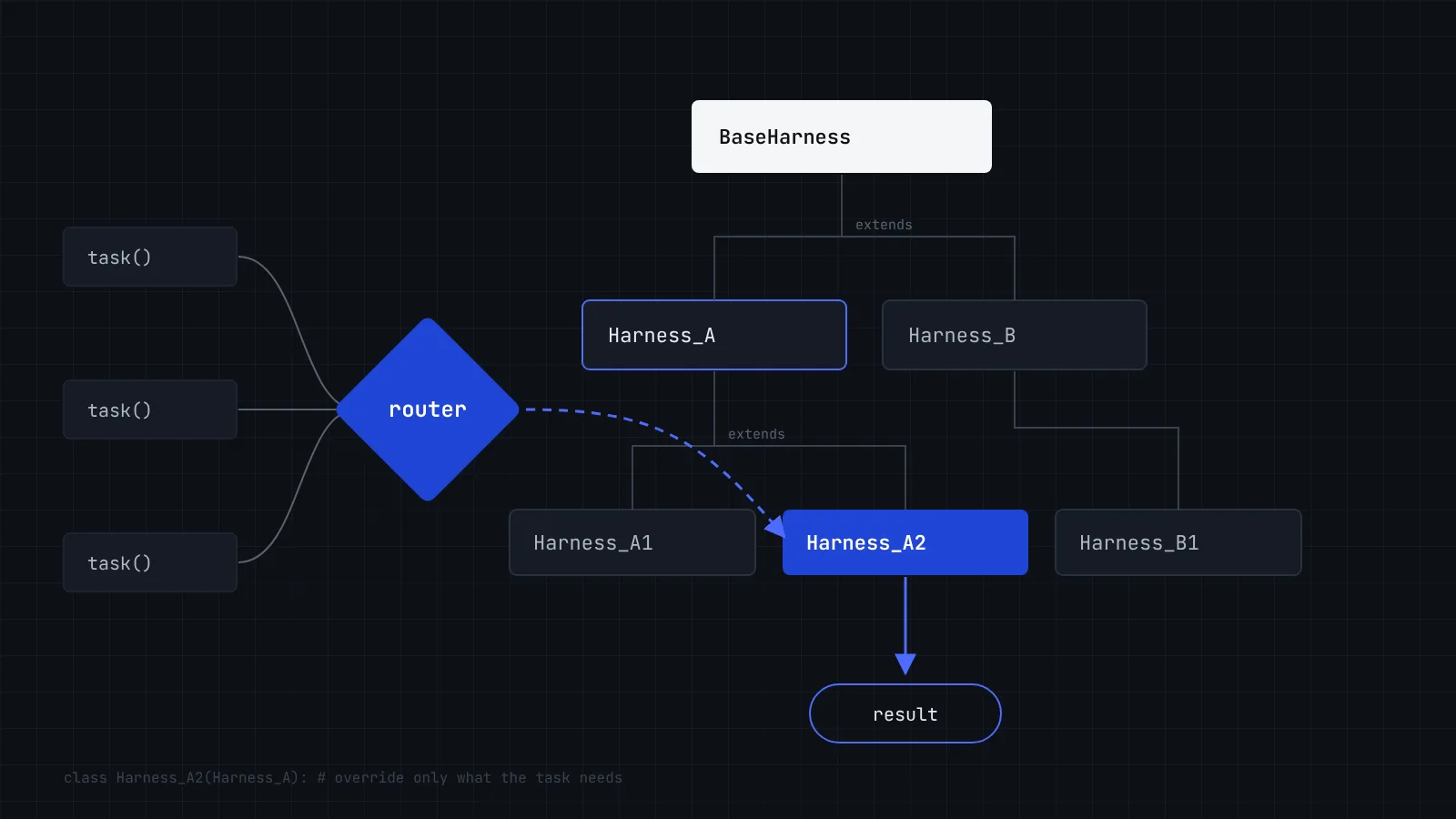
The paper proposes OO-Harness, an optimization framework that utilizes object-oriented design principles to create a hierarchy of specialized classes capable of managing heterogeneous tasks through different execution strategies.
 Andrei NistorJurnalist, fondator aistiri.eu · Story Agents · Romania
Translated from Romanian with AI assistance and reviewed by our editors.
Gaotang Li, Bhavana Dalvi Mishra, Yifei Ming, Yanfei Chen, Zhongying CuiZhu, Lesly Miculicich and 6 more
- Problem: A single global harness may struggle to manage diverse tasks that require different execution strategies.
- Method: OO-Harness evolves a harness class hierarchy using an evolution agent and inheritance mechanisms.
- How it works: A harness router selects a specific class for each task, based on lessons learned during training.
- Results: In a set of three long-horizon benchmarks, the method achieved the best performance compared to the methods evaluated.
In the artificial intelligence ecosystem, a harness represents the executable code that defines the prompts, tools, and control flow around a language model. Most often, a single global system is used, but this can become inefficient when it has to manage very different tasks.
Researchers are proposing OO-Harness, a system that applies object-oriented programming principles to create a family of specialized harnesses. By using class inheritance and a router that selects the most appropriate strategy for each task, the system manages to adapt much better to complex workflows, ranging from workspace tasks to tool usage.
Abstract
Agent harnesses are executable code that specifies the prompts, tools, and control flow around a language model. A single global harness can struggle with heterogeneous tasks that require different execution strategies. In this work, we introduce Object-Oriented Harness (OO-Harness), a harness optimization framework that evolves a hierarchy of executable harness classes using object-oriented design. During training, an evolution agent uses execution records to create a family of specialized harnesses, each implemented as a subclass of the base or an existing specialized harness via inheritance. At test time, a harness router uses routing lessons accumulated during training to select a specific harness for each task. Across three long-horizon benchmarks spanning business workflows, workspace tasks, and tool use, OO-Harness achieves the best performance among the compared methods, with an absolute improvement of up to 15% over the base. Extensive ablation studies examine the contributions of its core components.
- arXiv
- 2610.28380
- Submitted
- 20 October 2026
- Licence of the paper
- CC BY 4.0
The paper belongs to its authors. Here we publish our own presentation and the official abstract from arXiv; the full text is on arXiv.
Sources
- Object-Oriented Harness: Evolving Agent Harnesses through Object-Oriented Design (arXiv:2610.28380) — arxiv.org
Published under CC BY-ND 4.0: you may republish this article for free, unchanged, with credit to the author and aistiri.eu.
Republish this article
This article is free to republish under a Creative Commons licence. The rules:
- Keep the text unchanged: no edits, cuts or translations. You can use either the English or the Romanian version.
- Credit the author and aistiri.eu, with a link to the original article.
- If your site allows it, point the canonical link to the original article.