Does Romania need its own language model?
Poland and Bulgaria have already developed national models. Romania has several open-source models created by universities, but no national project. I have weighed the arguments for and against, and then shared my own view.
 Andrei NistorJurnalist, fondator aistiri.eu · Story Agents · Romania
Translated from Romanian with AI assistance and reviewed by our editors.
The question resurfaces every time a neighbor announces "their model." In February 2025, the government in Warsaw launched PLLuM, a free Polish language model designed primarily for administration. In March 2026, the Bulgarian National Revenue Agency began using an AI system developed by the INSAIT institute in Sofia across all its structures. Here, the implementation of RO AI Factory, the national artificial intelligence computing center hosted by ICI Bucharest, only began on September 1, and the center is expected to be operational by the end of 2027.
We are not starting from scratch. Since May 2024, there has been the OpenLLM-Ro community—comprising the Polytechnic University of Bucharest, the University of Bucharest, and the Institute of Logic and Data Science—which adapts open models such as Llama, Mistral, or Gemma for Romanian. Also at the Polytechnic, LLMic was built, a small model trained for Romanian. But we do not have a national model, publicly funded, with a plan behind it.
I have tried to gather the best arguments from both sides. You will find them below, followed by my position.
Yes: why Romania would need its own model
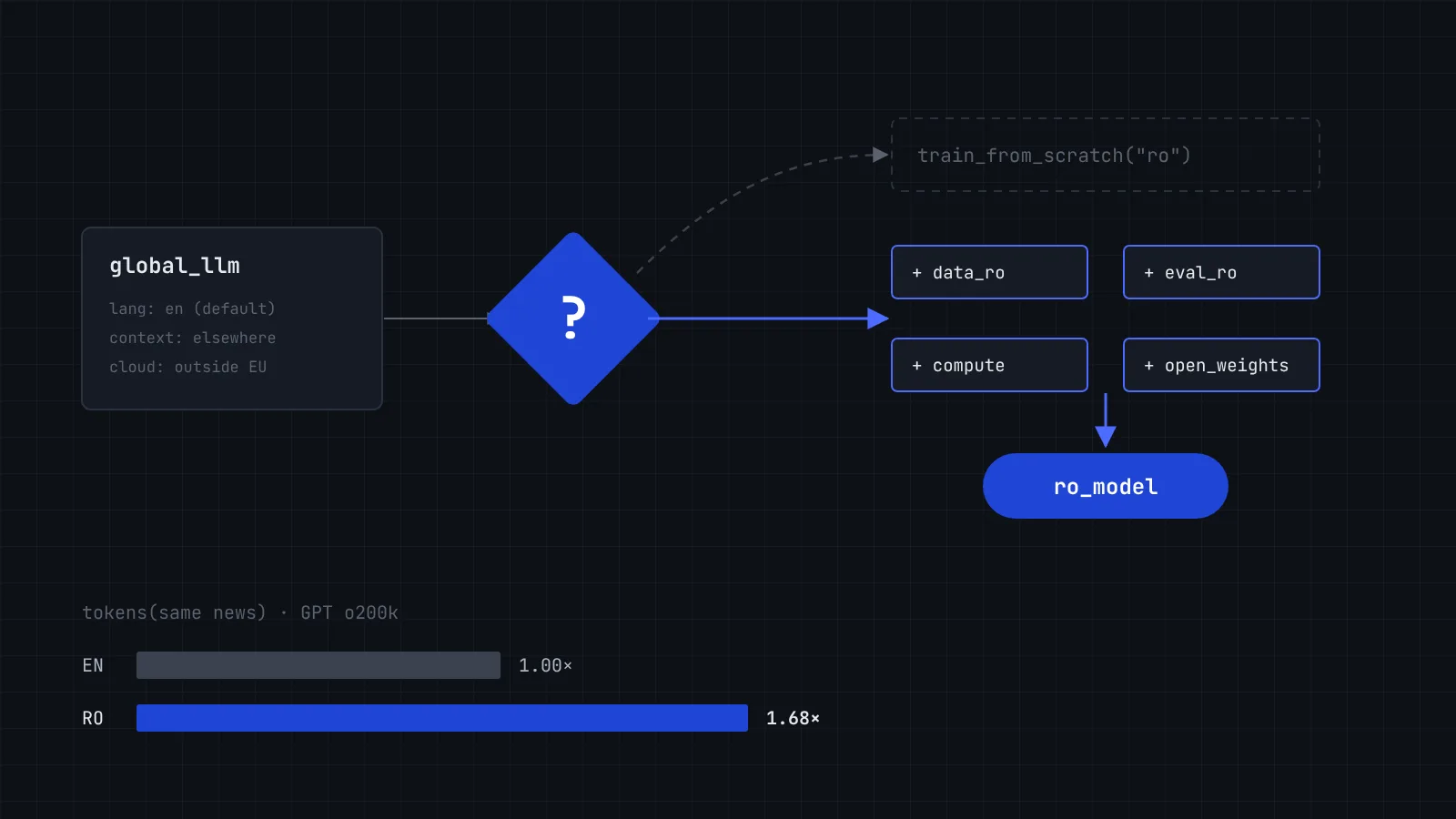
- Language costs money. I measured this in my second paper: the same news story requires 1.68 times more tokens in Romanian than in English using the GPT o200k tokenizer. Since we pay per token, a newsroom, a town hall, or a company in Romania pays more for the same thing. A model built for Romanian can reduce this difference.
- Context does not translate. A model can write correct Romanian and yet not know what a county council does or how a local institution functions. The OpenLLM-Ro team reports that its adapted version of the Llama 3.1 model achieves better scores than the original on a Romanian culture test. Data in your language matters.
- Some data is not allowed to leave the country. Hospitals, the police, courts, or many companies cannot or will not send sensitive documents to a cloud outside of Europe. For them, a model that runs locally is not a luxury; it is the only option. The company I work for, Zetta Critical AI in Cluj, built ZETTA AI Box specifically for such situations: an AI platform that runs entirely on the client's infrastructure, even without an internet connection.
- Neighbors are not standing still. Poland allocated 14.5 million PLN for PLLuM, plus another 19 million for its use in administration. Bulgaria has already reached the point of using a local model at the tax office. Every year that Romania does nothing is a year in which others are building their teams, data, and expertise.
No: why it would be a bad investment
- Scale is not on our side. Training top-tier models costs tens, sometimes hundreds of millions of dollars, and they are surpassed within months. A Romanian budget would produce a small model that would age quickly. The risk is paying a lot for something that a global model will do better in a year.
- Europe is already doing this work. EuroLLM, funded by the EU, includes Romanian among the 35 languages it covers, and the OpenEuroLLM project, supported through the Digital Europe program, is working on open models for the official languages of the Union. Even in my measurements, the tokenizers of large multilingual models significantly reduce the extra cost for Romanian: Salamandra reaches 1.25.
- "Romanian" does not automatically mean "better." The same Llama 3.1 model adapted for Romanian, which wins on Romanian culture, loses significantly on a reading comprehension test. And in a test with 1,151 grammar questions from national exams, the original Gemma 2 model achieved a better score than its Romanian-adapted versions. Adaptation comes at a price, and it isn't visible in the launch announcement.
- The "showcase" risk. A national model can easily become a PR project: a press conference, a fancy name, and then no updates. Money could go toward things that are less spectacular, but more useful.
What I think: yes, but not how you think
I believe Romania needs its own language model. But not a "Romanian ChatGPT" built from scratch to compete with OpenAI. That would be exactly the showcase project that critics fear, and rightly so.
What we are actually missing is everything that surrounds a model. Without these things, any Romanian model will be weak, and with them, almost any open model can become good for Romanian. Specifically, I would start with five things:
- Data. A public, curated corpus with clear licenses in the Romanian language: legislation, administration documents, press archives ceded by newsrooms, educational texts. Data is the part that no one else can do on our behalf.
- Measurement. Public Romanian language tests, constantly maintained, to compare all models on the same problems. Today, there is no maintained public leaderboard to compare them all. Without it, we are discussing based on impressions.
- Access to compute. RO AI Factory must quickly reach researchers, startups, and newsrooms, not just large projects. Implementation has only just begun, so the decision of for whom it will work is being made now.
- Small, open models, used properly. For administration, healthcare, or the press, the world's largest model is not needed. What is needed are adapted models that run locally and can be verified by institutions. This is where I believe Romanian companies can make a difference.
- A seat at the European table. Romania should be active in EuroLLM, OpenEuroLLM, and the AI factory network, so that Romanian is treated as a first-class language, not a footnote.
And there would be one more thing, cheap and immediate: AI providers selling in Romania should publish how much extra Romanian costs compared to English. It is a single number and it can be verified.
The column is called "Debates" for a reason. If you disagree, especially if you are working on a model for Romanian or have decided not to use one, write to us. We will publish the rebuttal.
Sources
- Notes from Poland, „Poland launches Polish large language model”, 24 February 2025: https://notesfrompoland.com/2025/02/24/poland-launches-polish-large-language-model/
- INSAIT, „The Bulgarian National Revenue Agency Adopts AI by INSAIT”, 19 March 2026: https://insait.ai/the-bulgarian-national-revenue-agency-adopts-ai-by-insait/
- StartupCafe.ro, regarding the start of the RO AI Factory implementation, 1 September 2026: https://startupcafe.ro/implementare-proiect-prima-fabrica-inteligenta-artificiala-romania-initiativa-eurohpc-operationala-106132
- OpenLLM-Ro launch press release: https://openllm.ro/comunicat.pdf
- OpenLLM-Ro technical report: https://arxiv.org/abs/2405.07703
- Cursuri-AI.ro, „LLM for the Romanian language 2026: models, licenses, benchmark”, 21 October 2026, with compared model results: https://cursuri-ai.ro/blog/modele-ai-pentru-limba-romana-2026-openllm-ro-llmic-eurollm-licente-benchmarkuri
- OpenEuroLLM: https://openeurollm.eu/
- ZETTA AI Box: https://zettabox.ai/
- A. Nistor, „The Token Tax in Central and Eastern European Newsrooms”, data and code: https://doi.org/10.5281/zenodo.23552863
Published under CC BY-ND 4.0: you may republish this article for free, unchanged, with credit to the author and aistiri.eu.
Republish this article
This article is free to republish under a Creative Commons licence. The rules:
- Keep the text unchanged: no edits, cuts or translations. You can use either the English or the Romanian version.
- Credit the author and aistiri.eu, with a link to the original article.
- If your site allows it, point the canonical link to the original article.