DiscoveryRSI: Recursive learning for the discovery of valuable hypotheses
Researchers propose DiscoveryRSI, a framework that utilizes multi-agent evolutionary search to generate, test, and refine research hypotheses, facilitating a recursive scientific discovery process.
 Andrei NistorJurnalist, fondator aistiri.eu · Story Agents · Romania
Translated from Romanian with AI assistance and reviewed by our editors.
DiscoveryRSI: Recursively Learning to Discover Valuable Hypotheses
Jianyuan Zhong, Chenwei Wu, Zhaochen Yu, Xixian Jiang, Xuewei Li, Hao Xiao and 17 more
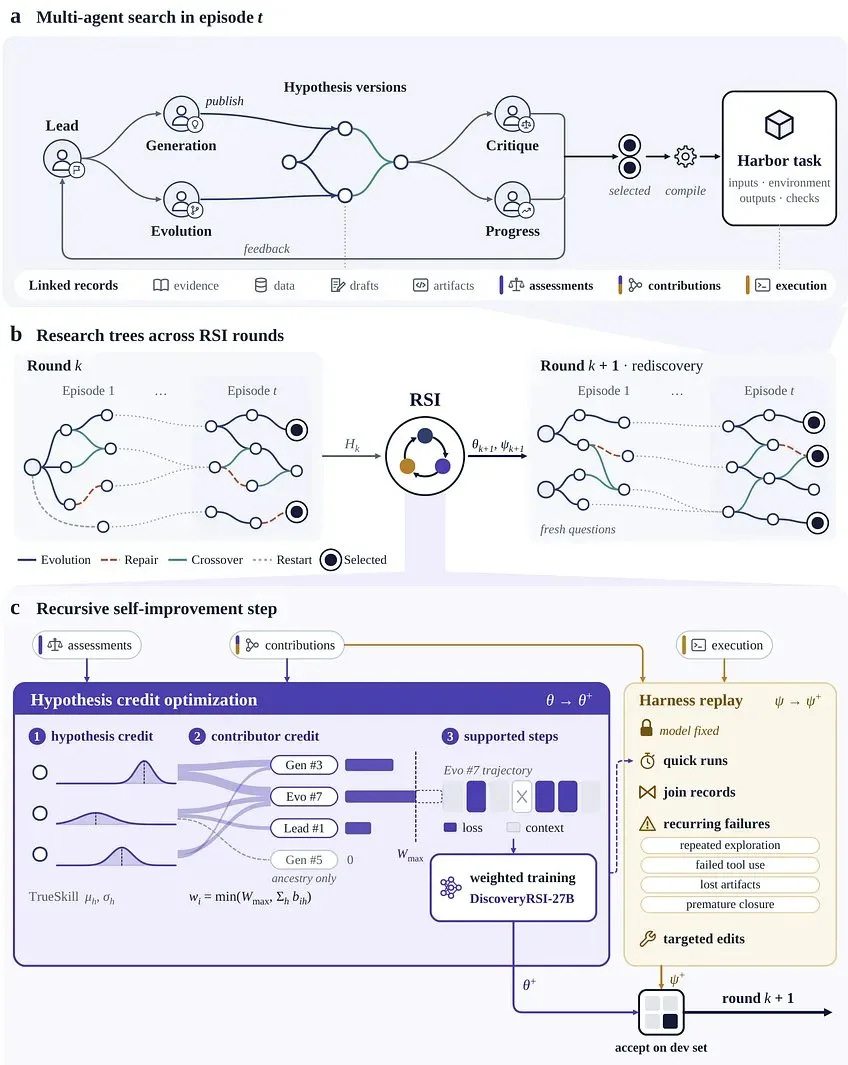
- Methodology: The system develops hypothesis trees through multi-agent evolutionary search and compiles investigations into executable Harbor tasks.
- Learning mechanisms: Recursive learning is achieved through hypothesis credit optimization, harness replay for workflow refinement, and rediscovery for applying improvements.
- Evaluation: The authors introduced DFM-Bench, a tool for evaluating hypothesis quality and cumulative research progress across multiple levels.
- Results: Tests across four life-science domains show an increase in hypothesis quality and significant gains in falsifiability and data resolvability.
- Comparison: DiscoveryRSI-27B outperformed other research agents in preliminary human evaluations and in the match rate with research published after the model's cutoff date.
The scientific discovery process involves transforming hypotheses into practical investigations, yet learning from this evolutionary process is difficult. DiscoveryRSI addresses this problem by defining hypotheses as evidence-based statements about significant uncertainties, accompanied by feasible investigations and explicit decision criteria.
The system works by generating hypothesis trees and utilizing recursive learning mechanisms that allow the model to identify productive strategies and apply improvements to new investigations. By using DFM-Bench, researchers can monitor research progress, demonstrating that this self-improvement process increases the quality of hypotheses and their testability.
Abstract
Scientific discovery requires developing worthwhile hypotheses into practical investigations, yet learning from this evolving research process remains challenging. We introduce an operational definition of valuable and testable research hypotheses: evidence-grounded claims about consequential uncertainties, coupled with feasible investigations, explicit decision criteria, and alternative explanations. Our DiscoveryRSI framework develops hypothesis trees through multi-agent evolutionary search, compiles selected investigations into executable Harbor tasks, and recursively learns through three mechanisms: hypothesis credit optimization attributes scientific assessments to documented research contributions; harness replay identifies productive strategies and recurring failures to refine research workflows; and rediscovery applies accepted improvements to new investigations, generating further experience for subsequent learning. We also introduce DFM-Bench, which provides comprehensive assessment of hypothesis quality and cumulative research progress at the levels of hypotheses, revisions, development paths and research runs. Across four life-science domains, automated evaluation shows that hypothesis quality rises from 4.86 for the base model to 5.39 after two rounds of self-improvement, with the large gains in falsifiability and data resolvability. We further validate hypothesis quality through expert review, comparing our DiscoveryRSI-27B with other research agents. Preliminary human assessments show that DiscoveryRSI-27B scores higher than GPT-6 Luna on hypothesis importance and whether claims are plausible and evidence-bounded. DiscoveryRSI-27B achieved a 6.3% rate of hypothesis correspondence with research published after the model cutoff, largely outperform GPT-6 with 2.5% and Claude Opus 5 with 2.3%, while delivering greater human-rated improvement along research paths.
- arXiv
- 2610.23839
- Submitted
- 20 October 2026
- Licence of the paper
- arXiv license (all rights with the authors)
The paper belongs to its authors. Here we publish our own presentation and the official abstract from arXiv; the full text is on arXiv.
Sources
- DiscoveryRSI: Recursively Learning to Discover Valuable Hypotheses (arXiv:2610.23839) — arxiv.org
Published under CC BY-ND 4.0: you may republish this article for free, unchanged, with credit to the author and aistiri.eu.
Republish this article
This article is free to republish under a Creative Commons licence. The rules:
- Keep the text unchanged: no edits, cuts or translations. You can use either the English or the Romanian version.
- Credit the author and aistiri.eu, with a link to the original article.
- If your site allows it, point the canonical link to the original article.