An AI model can write impeccable Romanian and still not understand Romania
The linguistic gap in language models isn't visible in grammar. It is visible in facts, in context, and in the question of who has the right to verify. This is where we started when we proposed the Linguistic Media Equity framework.
 Andrei NistorJurnalist, fondator aistiri.eu · Story Agents · Romania
Translated from Romanian with AI assistance and reviewed by our editors.
Anyone who has worked with a language model in Romanian knows the feeling. The text flows, the diacritics are in place, the sentences sound like news copy. And yet, something doesn't click. An institution is assigned duties it doesn't possess. A quote sounds plausible, but no one remembers it. A local event is recounted as if it had happened in an American city.
I wanted to understand where this discrepancy comes from, so I wrote a scientific paper about it: "The LLM Language Divide," which I presented this year at the TRUST 2026 conference. Its conclusion is simple to state and hard to fix. Language models do not perform equally well in all languages, and for the press, the difference matters more than for anyone else.
Where the gap comes from
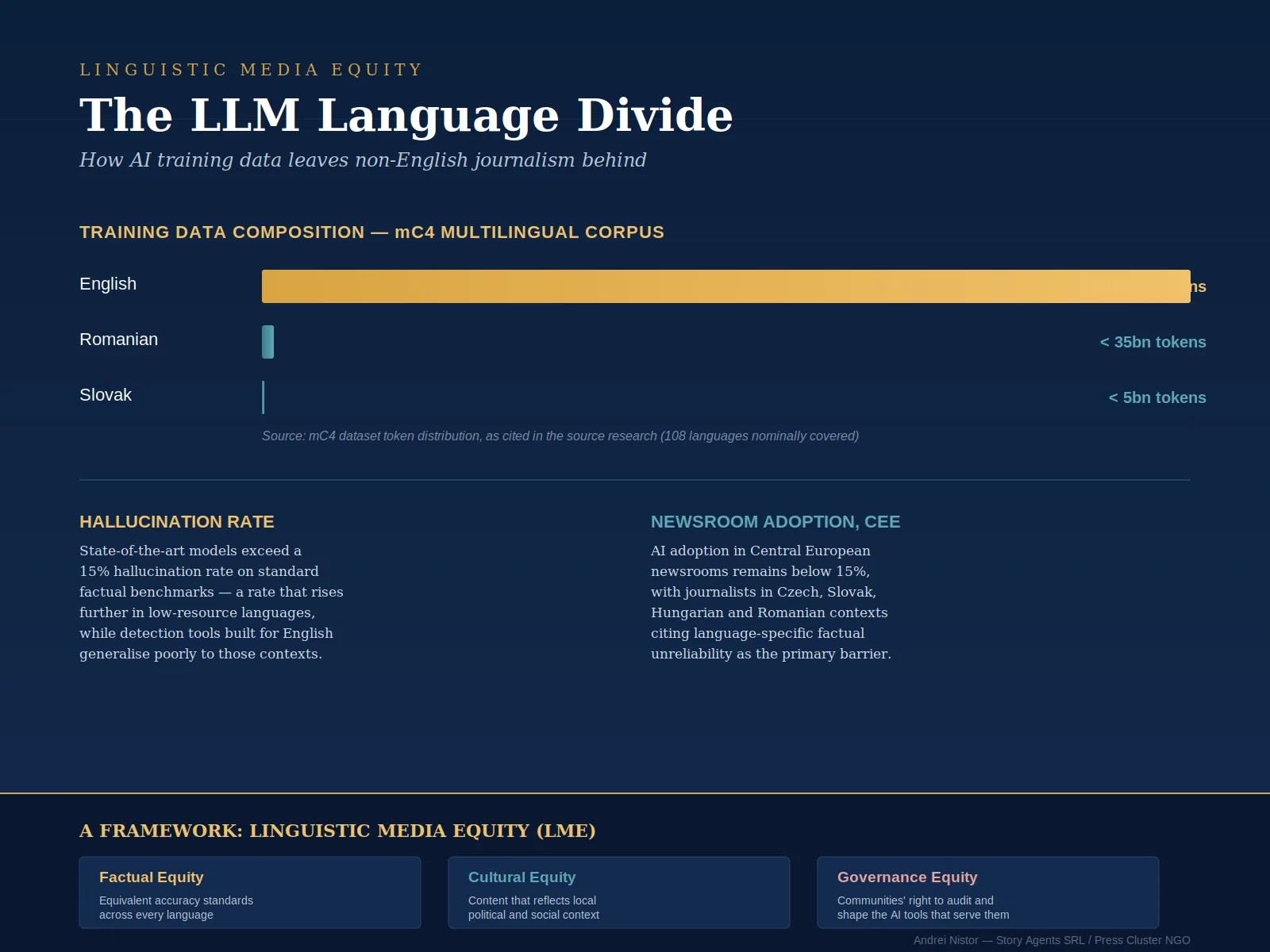
A language model learns from the texts it saw during training. It sees them all, but not in equal proportions. English overwhelmingly dominates the corpora on which large models are trained. Romanian, Hungarian, Slovak, or Bulgarian, although they are official languages of the European Union spoken by millions of people, occupy only small fractions there.
The consequence is not just that the model knows fewer Romanian words. It is more subtle. Grammar transfers relatively easily from one language to another. Context does not. A model can correctly construct a sentence about a county council without knowing what a county council actually does. Specialist literature has an expression for this, which I adopted in the paper: models speak with an "American accent," regardless of the language you write to them in.
There is another layer, which we usually treat as a technical matter: the way the model cuts text into pieces, i.e., tokenization. I will write about this separately in the next article, because there I had something to measure.
Three ways a model fails in a newsroom
In an ordinary conversation, a chatbot error is a nuisance. In a news story, it is a public problem. In the paper, I described three types of errors that matter particularly to the press.
- The invented quote. The model attributes a phrase to a politician or a spokesperson that they never actually said. The less the model knows about a country's public discourse, the easier it is for it to "complete" it plausibly.
- The wrong institution. The names are correct, but the attributions, competencies, or relationships between institutions are invented. This is the hardest error for a reader to catch, because everything looks credible.
- The skewed context. The text is grammatically correct, but views events through the lens of another political culture. An automated fact-checker has no way of catching this.
The unpleasant part is only just beginning. The tools that automatically detect model hallucinations also perform worse in smaller languages. The Mu-SHROOM scientific competition, organized in 2025 specifically for detecting hallucinations in multiple languages, showed that good methods for English do not transfer as well to other languages. So, newsrooms in the region receive two disadvantages at once: models that make more mistakes and tools that find those mistakes with more difficulty.
What Linguistic Media Equity means
If the problem is structural, it also needs a benchmark. In the paper, I proposed one and called it Linguistic Media Equity. The idea is this: a community has the right to AI-assisted journalism that respects the same standards of accuracy, cultural authenticity, and editorial reliability, regardless of the language in which it is produced. And when these standards are repeatedly not met in a language, we are no longer talking about a technical flaw, but about an inequality in access to information.
The framework has three dimensions.
- Factual equity. An AI tool used in Romanian should have the same factual error rate as in English. If it doesn't, the limits must be stated openly and managed by the newsroom.
- Cultural equity. The tool must understand the political culture, institutions, and collective memory of the community for which it writes. This is not achieved through translation alone.
- Governance equity. Communities have the right to verify how these systems behave in their language, to find out what data they learned from, and to have a say in how they are used.
What tomorrow's newsroom can do
I don't believe the solution is to give up on AI. Small newsrooms in the region are exactly those that need help the most and have the fewest resources. But we can work with our eyes open. Quotes, names of institutions, and their attributions are the places where models fail most easily in our language, so that is where human verification must reside. And a text that "sounds good" is not, by that, a correct text.
The paper is just the beginning. The next step was to move from argument to measurement, and the first dimension I could measure with figures was cost. That is what the next article in the series is about.
Published under CC BY-ND 4.0: you may republish this article for free, unchanged, with credit to the author and aistiri.eu.
Republish this article
This article is free to republish under a Creative Commons licence. The rules:
- Keep the text unchanged: no edits, cuts or translations. You can use either the English or the Romanian version.
- Credit the author and aistiri.eu, with a link to the original article.
- If your site allows it, point the canonical link to the original article.