The token tax: the same news costs more in Romanian than in English
I measured eight public tokenizers on news texts in Romanian, Hungarian, and Slovak. None come close to English, and the press pays the most.
 Andrei NistorJurnalist, fondator aistiri.eu · Story Agents · Romania
Translated from Romanian with AI assistance and reviewed by our editors.
When a newsroom uses a language model, it pays per token. A token is the piece of text the model works with: sometimes an entire word, sometimes a syllable, sometimes just a few letters. The price per token is the same for everyone. The number of tokens is not.
I took a news headline and ran it through the same tokenizer, GPT o200k, in four languages. In English, it had 18 tokens. In Romanian, 27. In Hungarian, 28. In Slovak, 33. The same news, a different invoice.
One example proves nothing, so I conducted a proper measurement. The result is my second paper, "The Token Tax in Central and Eastern European Newsrooms".
What I measured
I tested eight public tokenizers, ranging from those used by GPT models to those of models built in Europe. I applied them to 960 parallel text segments—meaning the same content translated into each language—and to 479 real news articles in Romanian, Hungarian, and Slovak. For each combination, I calculated how many more tokens a language needs compared to English to say the same thing.
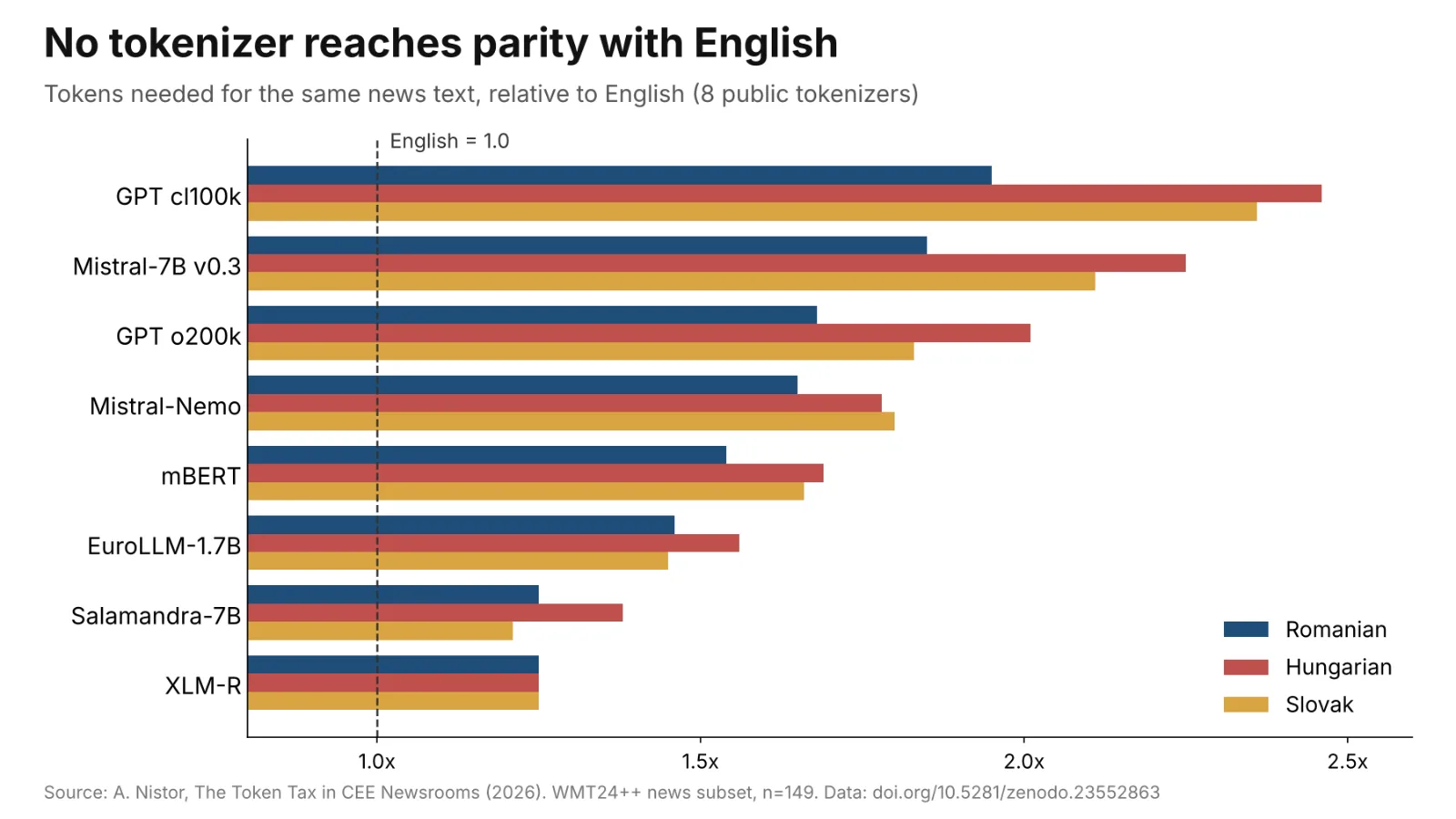
For news texts, the figures look like this (English = 1):
- GPT cl100k: Romanian 1.95, Hungarian 2.46, Slovak 2.36
- Mistral-7B v0.3: Romanian 1.85, Hungarian 2.25, Slovak 2.11
- GPT o200k: Romanian 1.68, Hungarian 2.01, Slovak 1.83
- Mistral-Nemo: Romanian 1.65, Hungarian 1.78, Slovak 1.80
- mBERT: Romanian 1.54, Hungarian 1.69, Slovak 1.66
- EuroLLM-1.7B: Romanian 1.46, Hungarian 1.56, Slovak 1.45
- Salamandra-7B: Romanian 1.25, Hungarian 1.38, Slovak 1.21
- XLM-R: 1.25 in all three languages
The short conclusion: no tokenizer reaches parity with English. Not one.
What this means for a newsroom
Let's take the GPT o200k tokenizer, used by very widespread models. The same news story needs 1.68 times more tokens in Romanian, 2.01 times in Hungarian, and 1.83 times in Slovak. Since the price per token is the same, the same budget buys a newsroom in the region roughly between half and 60% of what it buys for an English-language newsroom.
Money is only one part. Every model has a "context window," meaning a limit on the amount of text it can read at once. If Hungarian consumes twice as many tokens, a Hungarian newsroom fits into about half the space available to an English newsroom. This means fewer source documents to place alongside a draft and less material to check against what the model has written. The token tax, therefore, hits quality as well as the budget.
One thing surprised me. I compared several types of text, and news was the most expensive register in all three languages, across all tested tokenizers. In other words, tests built on general text underestimate exactly what the press pays.
Do European models help?
Yes, but they don't solve the problem. Tokenizers of large multilingual models significantly reduce the difference: Salamandra drops to 1.21–1.38, and XLM-R reaches 1.25 in all three languages. However, none achieve equality with English.
And vocabulary size doesn't explain everything. Mistral-Nemo and EuroLLM have very similar vocabulary sizes but very different results. What matters is how the vocabulary was built and from which texts, not just how large it is.
What you can do concretely
- Measure before you choose. Before committing a newsroom to a model, check how many tokens it needs for your actual texts, not the examples in the documentation.
- Compare tokenizers, not just the price per token. A lower price per token might end up being more expensive if the model chops your language into smaller pieces.
- Use open data. The data and code from the study are public, under open licenses (MIT code, CC BY 4.0 data), on Zenodo: https://doi.org/10.5281/zenodo.23552863. You can run them on your own articles.
The question remains as to who should regularly publish these figures. I believe it should be the AI providers, and that is the subject of the last article in this series.
Published under CC BY-ND 4.0: you may republish this article for free, unchanged, with credit to the author and aistiri.eu.
Republish this article
This article is free to republish under a Creative Commons licence. The rules:
- Keep the text unchanged: no edits, cuts or translations. You can use either the English or the Romanian version.
- Credit the author and aistiri.eu, with a link to the original article.
- If your site allows it, point the canonical link to the original article.